

Most businesses chasing Google rankings have no idea their potential clients are already typing questions into ChatGPT and getting answers that include competitor names. The shift is not coming. It is already here. And the brands showing up inside those AI-generated responses are not the ones with the biggest budgets. They are the ones whose content was structured, cited, and positioned in a way that large language models actually trust.
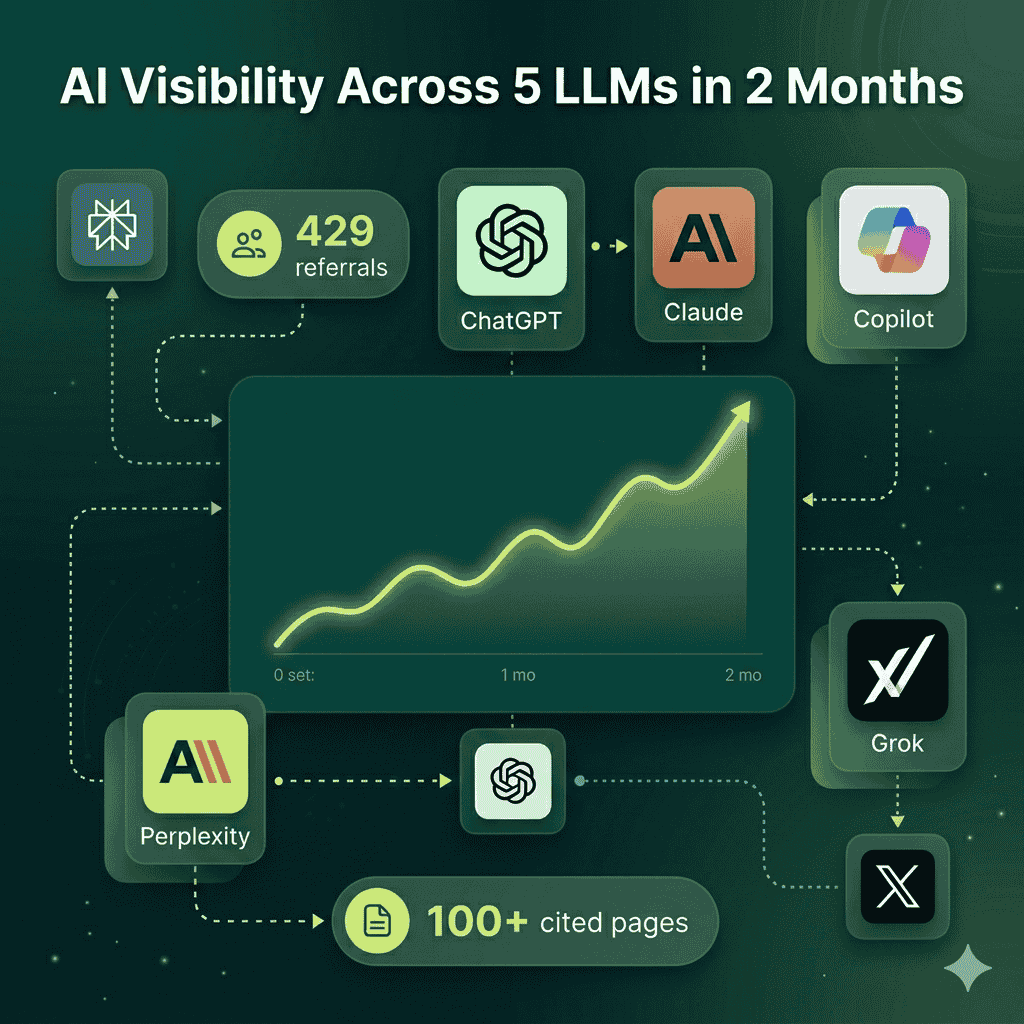
This case study documents exactly what happened when I applied a structured Generative Engine Optimization strategy to Pearl Lemon Leads, a UK-based B2B lead generation agency. Over two months, their content started appearing inside ChatGPT responses, Perplexity answers, Claude citations, Microsoft Copilot results, and Grok outputs. Google Analytics confirmed it all in real time.
If you are wondering whether GEO is real, measurable, and worth building a strategy around, the numbers here answer that question directly.
About Pearl Lemon Leads
Pearl Lemon Leads is a specialist lead generation agency based in the United Kingdom. They work with businesses across financial services, coaching, recruitment, and professional services, helping clients generate qualified leads through outbound prospecting, cold email, and appointment setting.
The agency operates in a crowded market where dozens of competitors chase the same search terms. Ranking on Google for keywords like “lead generation agencies in the UK” or “pay-per-lead services” requires sustained effort and authority. But showing up inside an AI-generated response when a business owner asks “which lead generation companies in the UK are worth using” is a completely different kind of visibility. One that paid search cannot buy and traditional SEO alone cannot guarantee.
That is the gap this GEO engagement was built to close.
The Three Problems We Were Solving
Before laying out the strategy, it is worth being specific about what the actual challenges were. GEO is not a vague concept. The problems it solves are concrete.
Visibility Gap
Pearl Lemon Leads had solid domain authority and years of SEO work behind them. But none of that automatically translated into AI visibility. Large language models do not rank pages the way Google does. They synthesize content from sources they consider authoritative, well-structured, and contextually relevant to the query. Pearl Lemon Leads was not showing up in those synthesized outputs despite having highly relevant content on their site.
Measurement Gap
There was no system to track which pages AI tools were citing or how much traffic those citations were generating. Most analytics setups at the time were not segmenting LLM referral traffic as a separate channel at all. Without measurement, there is no way to know what is working, what needs adjustment, or how to report meaningful results to a client.
Content Structuring Gap
Most content on the site was written for traditional search. Good for Google, but not optimally structured for AI consumption. LLMs prioritize content with clear question-and-answer formats, factual specificity, proper heading hierarchies, and authoritative citations. Reorienting existing content and new content toward these signals was a critical part of the engagement.
The GEO Strategy I Ran for Pearl Lemon Leads
The engagement ran across four interconnected workstreams. Each one addressed a specific layer of the visibility and measurement problem.
1. Structured Data Implementation
I added and enhanced structured data markup across the site using JSON-LD schema. The focus was on types that AI tools pay particular attention to including Organization, Service, FAQPage, BreadcrumbList, and LocalBusiness. This gave LLMs cleaner, more reliable metadata to work with when determining whether Pearl Lemon Leads was a credible and contextually relevant source for a given query.
Schema markup alone does not get you cited. But missing it creates signal noise that makes it harder for AI tools to process and categorize your content accurately. Fixing it removes that friction.
2. AI-Friendly Content Optimization
Existing pages were restructured to match how LLMs consume information. This meant:
- Rewriting introductory paragraphs to answer the core question of each page within the first 100 words
- Breaking content into clearly labelled sections with descriptive H2 and H3 headings
- Adding FAQ sections to commercial pages so AI tools had direct question-and-answer pairs to extract
- Removing redundant preamble that delayed the delivery of useful information
- Adding factual specificity including statistics, named processes, and detailed service descriptions that gave AI tools quotable, citable material
The goal was not to make content sound robotic. It was to make it answer-first. A human reading it would still find it useful and natural. An AI synthesizing it would have far cleaner material to work with.
3. Authority Building Through Third-Party Citations
LLMs trust content that is referenced from multiple credible sources. A page that exists only on its own domain has a limited footprint in the training data and live web index that AI tools draw from. I built out Pearl Lemon Leads’s presence on external platforms through:
- Publishing articles on industry-relevant third-party sites that mentioned and linked back to specific Pearl Lemon Leads pages
- Ensuring those mentions used natural, contextually appropriate language rather than over-optimized anchor text
- Building citations in directories, professional platforms, and niche sites that AI tools treat as credible reference points for UK lead generation services
This gave LLMs more surface area to encounter Pearl Lemon Leads as a recognized entity in the lead generation space rather than an isolated website.
4. Custom GA4 LLM Tracking Setup
This was foundational. Without a way to measure AI referral traffic, none of the other work could be validated. I built a custom tracking setup inside Google Analytics 4 that segmented sessions by referral source, specifically filtering for traffic arriving from known AI platforms.
The tracked sources included:
- chat.openai.com (ChatGPT)
- perplexity.ai (Perplexity)
- claude.ai (Claude)
- copilot.microsoft.com (Microsoft Copilot)
- grok.x.ai (Grok)
This gave a real-time, verifiable picture of how much traffic each AI platform was sending, which pages it was landing on, and how that volume changed over time. It turned GEO from a belief into a measurable channel.
The Results After 2 Months
Here is what the data showed across both Google Search Console and the GA4 LLM tracking setup after two months of structured GEO work.
Google Search Console: 6-Month Organic Overview
The six-month GSC picture for pearllemonleads.com shows the organic foundation the GEO work was built on top of.
[HERE INSERT IMAGE — GSC screenshot showing pearllemonleads.com with 7.41K clicks, 2.45M impressions, 0.3% CTR, 22.5 avg position over 6 months Sep 2025 to Mar 2026]
Google Search Console: pearllemonleads.com — 7.41K clicks and 2.45M impressions over 6 months (Sep 2025 to Mar 2026)
The 2.45 million impressions across six months showed that the site had significant keyword breadth and was surfacing for a wide range of relevant queries. The 0.3% CTR and 22.5 average position flagged a clear opportunity. Many pages were ranking on page two or at the bottom of page one, a zone where clicks drop sharply regardless of impression volume. This context made the GEO channel particularly valuable. AI citations do not depend on SERP position at all. A page ranking at position 22 on Google can still be cited at the top of a ChatGPT response if it is structured correctly.
GEO Results at a Glance
| Metric | Result |
|---|---|
| Total LLM Sessions | 429 |
| AI Platforms Generating Traffic | 5 |
| Unique Pages Cited by AI Tools | 100+ |
| Top Platform | ChatGPT (82% of sessions) |
| Measurement Period | 2 months |
These numbers came directly from the GA4 custom LLM tracking setup. Every session is traceable to a specific AI referral source.
Platform Breakdown: Where the 429 Sessions Came From
| AI Platform | Share of Sessions | Approx Sessions |
|---|---|---|
| ChatGPT (chat.openai.com) | 82% | ~352 |
| Perplexity (perplexity.ai) | ~8% | ~34 |
| Claude (claude.ai) | ~4% | ~17 |
| Microsoft Copilot | ~3% | ~13 |
| Grok (grok.x.ai) | ~3% | ~13 |
ChatGPT’s dominance at 82% of sessions is consistent with its position as the most widely used AI assistant globally. But the presence across Perplexity, Claude, Copilot, and Grok is what makes this result durable. Diversified AI citation means the brand is not dependent on any single platform’s algorithms or content policies.
Top Pages by LLM Sessions (Source: GA4)
| Page | Sessions |
|---|---|
| Homepage (/) | 93 |
| Unattributed AI Referrals | 49 |
| /pay-per-lead/ | 12 |
| /best-lead-generation-agencies-in-the-uk/ | 10 |
| /annuity-leads/ | 9 |
| /lead-generation-for-coaches/ | 6 |
| /outsourced-lead-generation-companies-in-the-uk/ | 6 |
The standout finding here is that commercial service pages were getting cited by AI tools, not just blog posts. Most people assume AI referrals will go to informational content. The data showed that properly optimized commercial pages like /pay-per-lead/ and lead generation service pages were being referenced directly in AI-generated answers. That means someone asking ChatGPT “what is the best pay-per-lead company in the UK” was being pointed to Pearl Lemon Leads’s actual service pages.
That is not awareness traffic. That is intent-matched, bottom-of-funnel traffic arriving from AI.
Four Key Outcomes From This Engagement
Proven AI Visibility
429 AI-driven sessions in two months validated GEO as a real traffic acquisition channel rather than a theory. The sessions were verifiable in GA4, traceable to specific referring domains, and distinct from organic, direct, or paid traffic. The result confirmed that a structured GEO strategy produces measurable outcomes on a timeline that matches traditional content marketing, not a multi-year SEO project.
Broad Content Coverage
Over 100 unique pages receiving AI referral traffic is a result of site-wide optimization rather than a few lucky pages. When an AI tool draws from your site for multiple query types, it signals that the domain is being treated as an authoritative entity in its niche, not just a one-page answer source. This breadth is also protective. If AI platforms change how they weight certain content types, a broad citation footprint is far more resilient than a narrow one.
Commercial Page Citations
The fact that /pay-per-lead/ and UK lead generation service pages earned AI-referred sessions is commercially the most significant finding in this case study. Informational content getting cited is expected. Commercial pages getting cited means the optimization successfully positioned Pearl Lemon Leads as a direct answer to purchase-intent queries inside AI tools. That is the actual business goal of GEO. Not awareness. Being recommended when someone is actively looking for what you sell.
Multi-Platform Presence
Citations across five AI platforms in two months means the brand has established visibility across the full landscape of mainstream AI search tools. Each platform has different user demographics, different use cases, and different recommendation logic. Showing up across all five removes single-platform dependency and protects the channel against individual platform changes.
What This Case Study Means for B2B Brands
Pearl Lemon Leads is a B2B service business in a competitive market. If GEO produced measurable, commercially relevant results for them in two months, the same approach applies to any B2B brand where decision-makers are starting their research on AI tools.
The playbook is not complicated, but it requires precision. Structured data, answer-first content, external citations, and proper measurement all need to work together. Doing one without the others produces partial results. Doing all four creates a compounding system where each month of implementation builds on the last.
The brands that start this process now will have established AI citation history when competition in this space increases. The ones who wait will be starting from zero in a market where others have already built up months of citation data, authority signals, and platform trust.
Frequently Asked Questions
How is GEO different from traditional SEO and do I need both?
Traditional SEO focuses on ranking in Google and Bing by building authority through backlinks, technical optimization, and keyword-targeted content. GEO focuses on getting cited by AI tools like ChatGPT, Perplexity, and Copilot when they generate answers for users. The two disciplines share a foundation in quality content and authoritative signals, but GEO requires restructuring content for AI consumption, building entity recognition across multiple platforms, and measuring a separate set of traffic sources. Most brands currently need both because Google still drives the majority of search traffic. But the share going through AI tools is growing fast, and starting GEO work now means building an advantage before the channel gets competitive.
How do you actually track LLM referral traffic in Google Analytics?
LLM referral tracking in GA4 works by creating custom segments or filters that isolate sessions where the session source matches known AI platform domains. The primary ones are chat.openai.com, perplexity.ai, claude.ai, copilot.microsoft.com, and grok.x.ai. Some AI traffic also arrives as direct traffic because certain interfaces strip referrer data, which is why the Pearl Lemon Leads data shows an unattributed AI referrals category. Building a clean tracking setup at the start of a GEO engagement is essential. Without it, AI traffic gets absorbed into the direct or referral buckets and stays invisible.
Why are commercial service pages getting cited by AI tools and not just blog posts?
AI tools do not distinguish between informational and commercial pages the way humans do. They index and synthesize any content that appears credible, well-structured, and contextually relevant to a query. When a commercial service page is written with clear headings, factual specificity, FAQ sections, and proper structured data, it becomes just as citable as an informational article. The key difference is intent alignment. When a user asks an AI “what are the best pay-per-lead companies in the UK,” the AI looks for pages that directly address that question. A well-optimized commercial page answers it more directly than a generic blog post about lead generation theory.
How long does it take to see measurable GEO results?
The Pearl Lemon Leads results appeared within the first two months of structured implementation. That said, the timeline varies depending on the domain’s existing authority, how much content restructuring is needed, and how aggressively the external citation work is executed. Sites with strong existing domain authority and a large content library tend to see results faster because AI tools already have more surface area to draw from. Newer sites or those with thin content may take three to six months before the citation footprint becomes measurable. The tracking setup can be deployed from day one, so you start capturing data immediately even if citation volume builds over time.
Does GEO help with organic Google rankings too?
Indirectly, yes. The signals that make a site perform well for GEO including structured data, authoritative external citations, clear content hierarchies, and factual specificity are also signals that Google values for traditional search ranking. A GEO-optimized page is generally a better SEO page than one that has not been through that process. The reverse is not always true. A page optimized purely for Google keywords is not necessarily positioned well for AI citation. Brands that invest in GEO tend to see incremental organic search improvements as a side effect, while brands that invest only in traditional SEO miss the AI channel entirely.
A Closing Thought
The data from this Pearl Lemon Leads engagement is not a projection or a hypothetical. It is 429 real sessions, from five real AI platforms, landing on real pages across a real site, tracked inside GA4 over two months of structured GEO work.
The question worth sitting with is not whether GEO works. This case study answers that. The question is which of your competitors is going to be the first one in your market to build this kind of AI citation presence, and whether that is going to be you or them.