

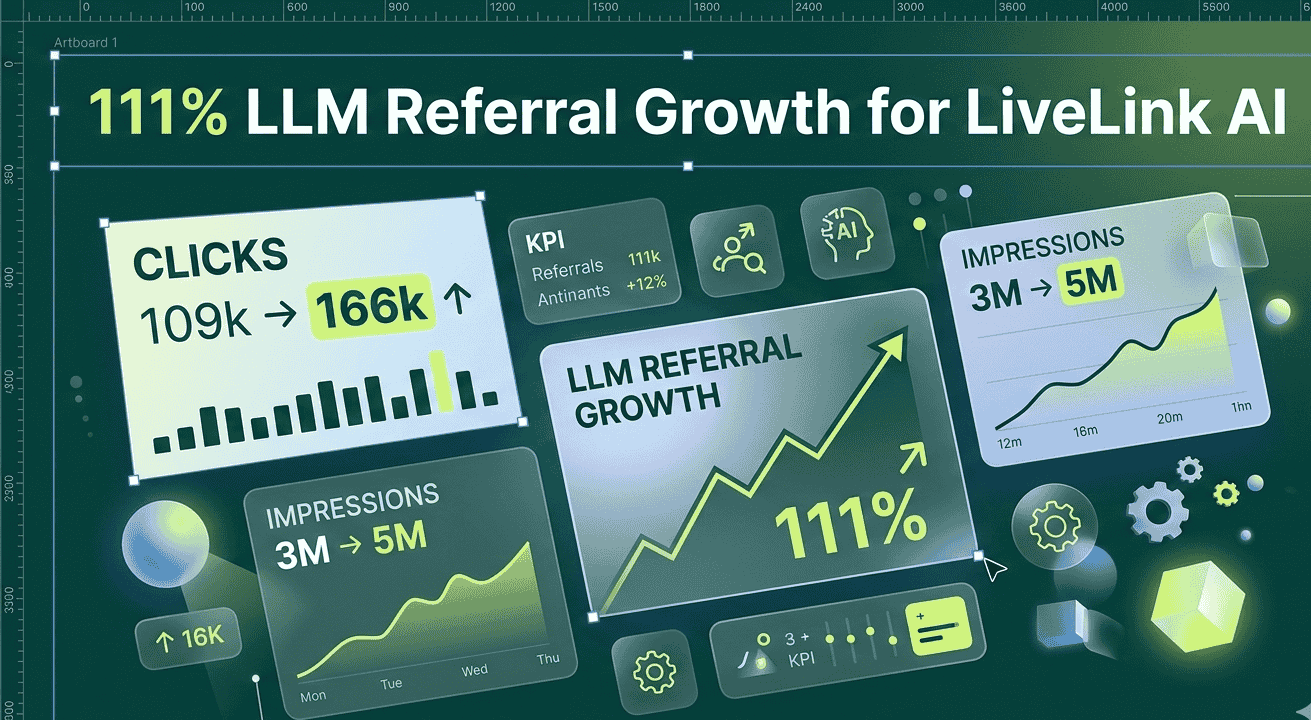
Most SaaS companies pouring money into paid ads are quietly bleeding budget while their organic channel sits untapped. LiveLink AI was different. They had a product worth talking about, a growing user base, and a real shot at owning search real estate in the AI video clipping space. What they needed was a clear SEO and GEO strategy that matched the pace of how their market was moving.
I worked with LiveLink AI for four months as their SEO and GEO manager. This case study breaks down exactly what I did, what the data looked like before and after, and the specific moves that produced results you can see in Google Search Console and Google Analytics.
If you are running a SaaS product and wondering whether organic search and AI-driven referrals are actually worth investing in, the numbers here should give you a clear answer.
About LiveLink AI
LiveLink AI is an AI-powered video clipping tool built for content creators and marketers. The platform takes long-form video content and automatically cuts it into short, shareable clips formatted for TikTok, YouTube Shorts, Instagram Reels, and Snapchat. It comes with automatic captioning, face tracking, custom brand templates, and direct social media scheduling.
The product serves over 50,000 creators and operates in a highly competitive space alongside tools like Opus Clip and Vidyo.ai. LiveLink AI is backed by strong technical infrastructure and has integrations powered by OpenAI, which means the product itself was never the issue. The gap was visibility and discoverability, both on traditional search engines and inside AI-powered tools that creators now use to find software recommendations.
The Situation Before I Came In
Before the engagement started, LiveLink AI had decent organic presence but no structured SEO system. They were using Webflow CMS to manage their content but were not publishing at a pace or depth that would let them compete for high-intent keywords. Their blog had potential but lacked the topical authority signals that Google uses to rank pages consistently.
The baseline numbers from GSC for the three months prior to my work showed:
- 109,000 organic clicks
- 3.01 million impressions
- Average position of 15.6
- CTR of 3.6%
LLM referrals, meaning traffic coming from AI tools like ChatGPT, Perplexity, and similar platforms recommending LiveLink AI, stood at just 584 sessions. This was one of the biggest missed opportunities I noticed immediately. With AI tools becoming a primary discovery channel for software, a product like LiveLink AI had every reason to be showing up in those recommendations.
The signup completion data was also telling. The Signup Finish event in Google Analytics was tracking completed registrations, and there was clear room to push those numbers higher through better top-of-funnel content and stronger brand authority.
The 4-Month SEO and GEO Strategy
I approached this engagement in five interconnected workstreams. None of these operated in isolation. Each one fed into the others, which is why the growth compounded rather than plateaued after a few weeks.
1. AI Content Writing With Topical Authority in Mind
The first and most important piece was content. I wrote and published SEO-focused articles designed to build topical authority around the keywords that LiveLink AI’s target users were actually searching for. These were not generic blog posts stuffed with keywords. Each piece was written to fully answer a specific question, address a real pain point, or cover a competitor comparison that creators were already researching.
The content strategy prioritized three categories of keywords:
- High-intent, bottom-of-funnel terms like “best AI clip maker” and “Opus Clip alternative”
- Educational, middle-of-funnel content about video repurposing, short-form content strategy, and AI video tools
- Feature-specific pages targeting creators looking for automatic captions, face tracking, and YouTube Shorts tools
Every article was written to satisfy both the human reader and the AI tools that scrape and synthesize content when users ask ChatGPT or Perplexity for software recommendations. This is the GEO component, which I will explain in more detail shortly.
2. Publishing on Webflow CMS
LiveLink AI runs on Webflow, which is excellent for design but requires careful handling when it comes to technical SEO. I personally handled the publishing workflow inside Webflow CMS rather than handing off to a developer. This meant I could control the exact structure of each published page including meta titles, meta descriptions, heading hierarchies, schema markup, and internal linking patterns.
A common issue with Webflow sites is that content gets published without proper canonical tags, slug structures, or image alt text. I built a pre-publish checklist that was applied to every piece of content before it went live, which eliminated the kind of technical debt that quietly drags down rankings over time.
3. Direct SEO Implementations
Beyond content, I ran a full SEO audit at the start of the engagement and prioritized fixes based on potential impact. The implementations included:
- Schema markup for software application, FAQ, and breadcrumb structured data
- Internal linking overhaul to pass authority from high-ranking pages to newer content
- Page speed improvements by optimizing image delivery and reducing render-blocking elements
- Fixing crawl issues and redirect chains that were diluting link equity
- Updating title tags and meta descriptions on underperforming pages with high impression volume but low CTR
The CTR improvement work alone had a measurable impact. Pages with 10,000 or more impressions but a sub-2% CTR were individually reviewed and updated. Even small improvements in CTR on high-impression pages translate to significant click volume at scale.
4. Link Building
Authority signals still matter. A content strategy without link acquisition is like building a house with no foundation. I ran an outreach-based link building campaign focused on getting LiveLink AI mentioned and linked from relevant websites in the creator economy, marketing tech, and video production spaces.
The focus was on editorial links, not directory spam or PBN placements. These were genuine mentions secured through outreach to bloggers, newsletter writers, and niche site owners who covered tools for content creators. Each link was evaluated for relevance, domain authority, and traffic quality before pursuing.
5. GEO: Getting LiveLink AI Into AI Recommendations
Generative Engine Optimization is still a relatively new practice, but the impact is very real. When someone types “what is the best tool to turn long videos into short clips” into ChatGPT or Perplexity, the answer they get is shaped by what content exists on the web and how authoritatively that content presents certain products.
I worked on getting LiveLink AI mentioned and cited in third-party articles, comparison posts, and tool roundups published on external platforms. These brand mentions and backlinks from high-quality, contextually relevant sources gave AI models more signal to associate LiveLink AI with the problem it solves.
The result: LLM referral traffic went from 584 sessions to 1,232 sessions over the four-month period. That is a 111% increase in traffic coming directly from AI-powered tools recommending LiveLink AI to users.
The Results After 4 Months
Here is a direct comparison of the key metrics before and after the engagement, pulled directly from Google Search Console and Google Analytics.
| Metric | Result | Change |
| Organic Clicks | 166k | +52.3% |
| Impressions | 5.04M | +67.4% |
| Avg. Position | 11.9 | From 15.6 |
| LLM Referrals | 1,232 | +111% |
| Signup Finishes | 48k events | +59.9% |
| New Signups | 43k users | +59.7% |
These numbers are not projections or estimates. They come directly from LiveLink AI’s own analytics accounts.
Google Search Console: Clicks and Impressions
The comparison view in GSC tells the clearest story. Over the previous three months, the site was generating 109,000 clicks and 3.01 million impressions. During the period I managed SEO, those numbers moved to 166,000 clicks and 5.04 million impressions.
That is a 52.3% increase in clicks and a 67.4% increase in impressions. The growth in impressions outpacing clicks is expected when you significantly expand keyword coverage. More pages rank for more queries, which drives impressions up. As those pages age and accumulate engagement signals, clicks continue to rise.
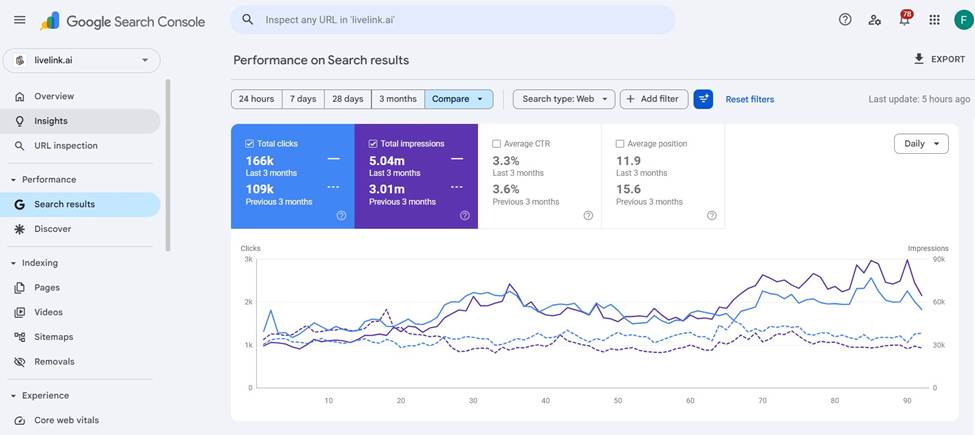
Google Search Console: 166k clicks and 5.04M impressions vs 109k clicks and 3.01M impressions in the previous period
Average Position Movement
The site moved from an average position of 15.6 to 11.9. That 3.7-position improvement across the entire domain is significant because average position is a blended metric. Moving it that much means hundreds of individual keywords moved up in rankings, not just a handful of pages.
Position 11.9 puts the site consistently in the second result of the first page or close to the top of the first page across a large keyword set. The next phase of this work would push the highest-volume keywords into the top five, where click-through rates increase dramatically.
Signup Finish Events: Real Business Impact
Traffic growth means nothing if it does not lead to user action. The Signup Finish event in Google Analytics tracks completed account registrations, which is the most direct conversion metric for a SaaS product.
Signup Finish events grew by 59.9%, from the baseline to 48,000 events. The total users who completed signup grew by 59.7% to 43,000. This is the metric that actually matters to a business, and the SEO work contributed directly to it by bringing in higher-quality, intent-driven traffic.
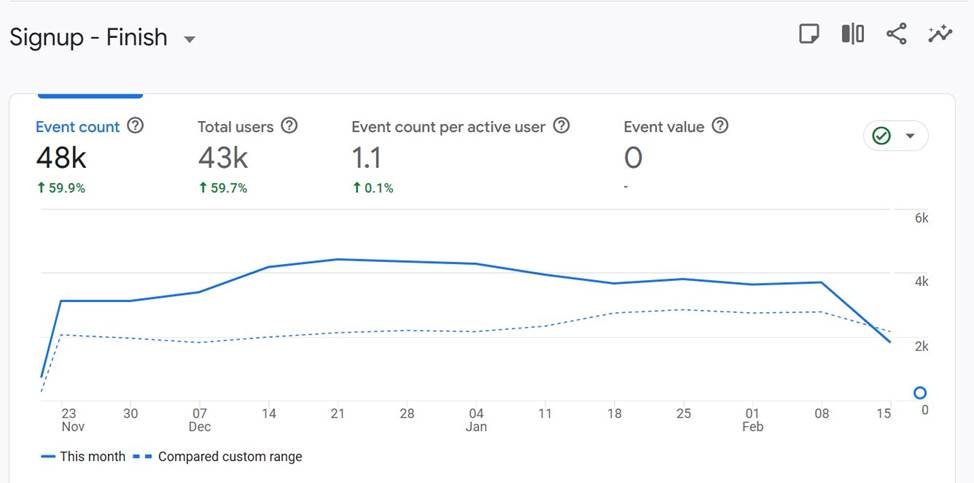
Google Analytics: Signup Finish events up 59.9% with 48k completions and 43k new users in the comparison period
LLM Referrals: The GEO Payoff
This is the metric most SEO agencies are not even tracking yet. LLM referrals measure how much traffic arrives at a site because an AI tool recommended it. Going from 584 to 1,232 sessions represents 111% growth in this channel.
For a product like LiveLink AI that targets creators who live on these tools, showing up in AI-generated recommendations is a durable competitive advantage. Unlike a paid ad that disappears when the budget runs out, a strong GEO presence compounds as more content referencing the product gets indexed and cited.
What This Engagement Taught Me About SEO for AI Tools
Working on a product in the AI tools category is different from traditional SaaS SEO in a few important ways.
- The competitive set changes fast. New tools launch every week and old tools pivot. Keyword monitoring and competitor tracking need to be more frequent.
- AI-generated content comparisons are now a real traffic source. When someone asks an AI what tool to use, that interaction can drive a direct signup. GEO is not optional for AI tool companies anymore.
- User intent is more layered. Creators searching for clip tools are at different stages. Some want to understand the technology, some are comparing options, and some are ready to start a free trial right now. Content needs to address all three stages.
- Webflow is a solid CMS for SEO when you handle the technical side yourself. Relying on designers to manage SEO in Webflow leads to gaps that quietly erode performance over time.
Frequently Asked Questions
How long does it take for SEO to show results for a SaaS product?
For most SaaS products in competitive niches, the first meaningful signals appear between 60 and 90 days. Full momentum typically builds between months three and six. The LiveLink AI results starting showing in GSC impressions around week six of the engagement, with click growth following shortly after. The key is consistent content publication and technical implementation from day one rather than front-loading one and neglecting the other.
What is GEO and how is it different from traditional SEO?
Search Engine Optimization targets ranking in Google, Bing, and similar search engines. Generative Engine Optimization targets the recommendations made by AI tools like ChatGPT, Perplexity, Claude, and Gemini. Traditional SEO focuses on keywords, backlinks, and on-page signals. GEO focuses on brand mentions, content quality, third-party citations, and making sure the language used to describe a product matches the queries people ask AI tools. Both disciplines share a foundation in quality content and authoritative signals, but GEO requires thinking about how large language models synthesize and surface information rather than just how ranking algorithms score pages.
Does link building still matter in 2025?
Yes, significantly. Despite years of predictions that links would become less important, they remain one of the strongest signals search engines use to evaluate the authority and trustworthiness of a domain. The difference in 2025 is quality versus quantity. A single editorial link from a relevant, high-traffic site in the creator tools space is worth more than hundreds of directory listings or low-quality guest posts. For AI tool companies specifically, these same editorial links also feed into LLM citation patterns, making link building valuable for both traditional SEO and GEO simultaneously.
How do you measure GEO results?
GEO measurement is still an emerging practice. The most practical method currently is tracking LLM referral sessions in Google Analytics by filtering traffic sources for known AI platforms such as chat.openai.com, perplexity.ai, claude.ai, and similar. Some analytics platforms have started adding dedicated AI referral segments. Brand mention monitoring tools can also track how often a product name appears in AI-generated content across the web. For LiveLink AI, the LLM referral traffic figure in GA was the primary GEO success metric.
What makes content rank well for both humans and AI tools?
Content that ranks well in both channels shares the same core characteristics: it answers specific questions completely, it attributes claims clearly, it uses natural language that matches how people actually describe their problems, and it earns citations from other reputable sources. The format matters too. Headers that match common question formats, structured sections with clear answers, and factual specificity all help AI tools extract and cite information accurately. Writing for AI tools is not about stuffing brand names into content. It is about creating the kind of authoritative, specific, well-cited content that any good researcher would want to reference.
A Closing Thought
The LiveLink AI engagement was not built on any single tactic. The 52% click growth, 67% impression growth, 59.9% signup completion increase, and 111% LLM referral growth all came from consistent execution across content, technical SEO, link building, and GEO working together over four months.
The brands that will own their categories in the next few years are the ones building both their Google presence and their AI recommendation presence right now. Those two channels are merging faster than most marketing teams realize, and the window to establish authority before the space gets even more competitive is narrower than it looks. If your SaaS product has a real solution to a real problem, the question is not whether SEO and GEO are worth doing. The question is how much longer you can afford to wait while competitors fill that space ahead of you.